How to Become the Primary Source in Your Industry

Multi-Channel SEO in 2026: Stop Chasing Rankings — Start Building Authority
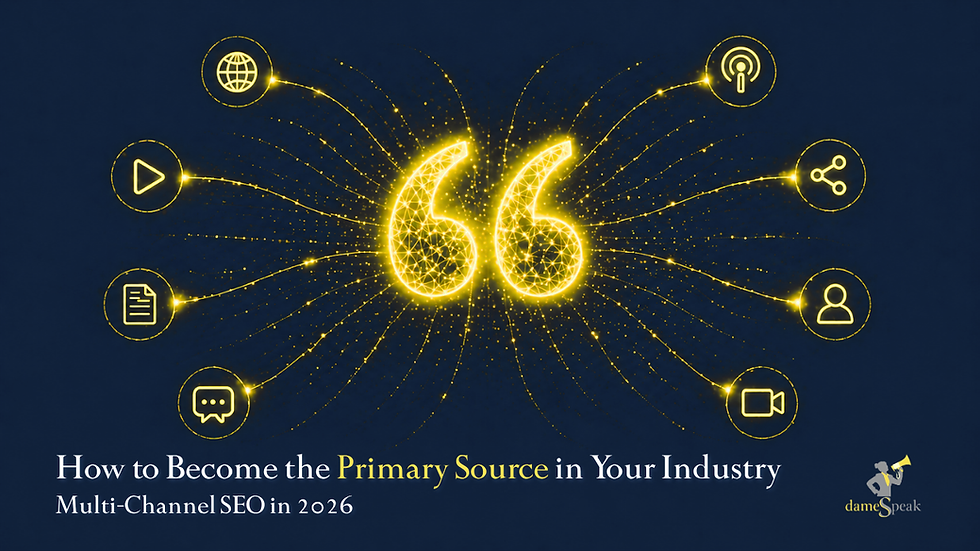
If your customers have to look for you, you're already behind.
Search has fundamentally changed. Your audience doesn't follow a straight line from query to click anymore — they zigzag from TikTok to Google to ChatGPT to Reddit and back again. And in 2026, the brands winning visibility aren't just ranking. They're being cited. Referenced. Recommended. By search engines, by AI tools, by other people in their community.
That's what primary source status means — and it's the goal every business should be building toward.
When Search Isn’t Just Search Anymore
Remember when SEO meant sprinkling in keywords and watching your Google rank climb?
Cute.
Today’s buyer journey doesn’t follow a straight line — it zigzags from TikTok, to Google, to AI Overviews, to Reddit threads, and maybe back to TikTok. Users aren’t just searching; they’re discovering, validating, comparing, and deep-diving — often in one sitting.
If you want to win, your content needs to show up everywhere they go. Not just rank — lead.
That means building a brand so trusted, so informative, and so frequently cited that AI tools, search engines, and social platforms all recognize you as the source worth quoting.
Why Primary Source Status Changes Everything
When AI starts synthesizing the web, you don't want to be summarized. You want to be cited.
Primary source status means your business is the expert everyone references — search engines, AI tools, other content creators, and the people your customers trust for recommendations. That status gives you something that traditional SEO rankings alone can't: visibility that's platform-independent and increasingly difficult for competitors to displace.
Bottom line: when you become the reference, you stop playing the ranking game and start defining it.
Understanding the New Search Landscape
Your audience doesn't search in one place anymore. To build primary source status, you need to understand what role each platform plays in how people find and validate information — and create content that speaks the native language of each.
Each platform has its own vibe and intent. The magic happens when your content speaks the native language of each.
Your Multi-Channel Authority Game Plan

Expand Your SEO Mindset Beyond Google
Google is no longer the only search platform that matters. Your strategy needs to account for where your specific audience actually searches — not just where you've always focused.
Check Google Analytics for rising non-Google traffic sources. Understand the content formats and community norms of each platform your audience uses. Allocate resources based on where real engagement is happening, not old habits.
Match Content to Search Intent and Platform
Not all platforms serve the same purpose. The most effective multi-channel strategy maps your content to the intent behind each platform — creating content that fits where your audience is in their decision process, not just what you want to say.
You’re not creating content for content’s sake. You’re matching tone, format, and purpose — strategically.
Get Cited by AI Tools — Not Just Ranked by Google
AI tools don't scroll — they synthesize. Getting cited requires a different optimization approach than traditional ranking. The most effective steps for building AI citation likelihood in 2026 are:
Answer questions directly in the first sentence of each section — don't build up to your point.
Use clear question-based headings that match how your audience actually phrases queries.
Publish original data, frameworks, and perspectives that AI tools have a specific reason to attribute to your brand rather than paraphrase generically.
Implement schema markup across every key page so AI systems have machine-readable confirmation of what your content covers and who created it.
Build topical depth through organized content clusters — a site that comprehensively covers a subject area is significantly more citable than one with isolated pages on the same topic.
Make Your Content Worth Quoting
In an era of AI-generated generic content, the bar for what earns attention — and citations — has risen significantly. Content that gets referenced is original, useful, and specific. It says something actually new, solves a real problem your audience has, and delivers insight that isn't available anywhere else in exactly that form.
This is the content users share in Slack channels, link to in their own writing, and reference in comment sections. It's not just good SEO. It's thought leadership that compounds in value over time.
Define and Dominate Your Topical Territory
Broad coverage across many loosely related topics doesn't build primary source status. Depth on a clearly defined subject area does. Pick the two or three topics most central to your business and build comprehensively around them — pillar pages, supporting cluster articles, FAQ content, and internal links connecting everything into a system.
When search engines and AI tools see a cluster of interconnected, consistently authoritative content all pointing to the same topical expertise — that's when your brand starts being treated as the reference rather than just another result.
Stay Adaptable — Platforms and Algorithms Will Keep Changing
The platforms change. The algorithms evolve. Search behavior shifts. The brands that maintain primary source status are the ones that build adaptable strategies — not ones that optimize for a single platform or a single moment in time.
Track emerging platforms where your audience is moving. Update your KPIs to reflect current search reality — organic traffic alone doesn't tell the full story in 2026. And treat your content strategy as a living system, not a one-time project.
Where Search is Headed — and Why Authority Wins
Here’s where it’s all going:
AI tools will prioritize trustworthy sources.
Users will favor expert-backed insights over AI noise.
Brands will need to prove their authority across multiple platforms, not just one.
And that means the brands that think like primary sources will win. Not just in SEO. Not just in social. But everywhere their audience is searching.
Be the Brand They Can’t Ignore
Search isn't linear anymore. It's layered, fragmented, and constantly shifting across platforms your audience uses simultaneously. The brands winning in that environment aren't the ones with the most content — they're the ones that have built the deepest authority in the places that matter most to their specific audience.
Stop chasing rankings. Start building reputation. Stop publishing content for content's sake. Start becoming the source your industry references.
That's what dameSpeak builds for our clients — and it's available to any business willing to invest in doing it right.
Frequently Asked Questions About How to Become the Primary Source in Your Industry