
The AI-Driven Marketing Tools Worth Your Budget (and the Ones That Aren't)

Updated: Sep 1

Key Takeaways
AI adoption in business is now mainstream, not cutting-edge. 88% of organizations report regular AI use in at least one business function, up from 78% a year earlier — but most are still stuck in pilot mode, not scaled use (McKinsey, 2025).
Small businesses are catching up fast. 67% already use AI for content and SEO, and 65% report better SEO results because of it (Semrush).
The time savings are real and significant. About a third of marketing teams say AI saves them 10-14 hours a week, and another third say 15+ hours (HubSpot, 2026).
Not every AI tool deserves a spot in your stack. The ones worth paying for cluster into a handful of categories — content generation, customer service, ad targeting/personalization, analytics, and AI search optimization.
Adoption without a plan wastes money. The gap between companies using AI and companies seeing real revenue impact from it is wide — a clear starting point matters more than a long tool list.
AI-driven marketing tools stopped being optional somewhere in the last two years. If you're a small or mid-sized business owner, you've probably already tried at least one — a writing assistant, a chatbot, an ad platform's "smart" targeting feature. The question isn't whether to use AI in your marketing anymore. It's which tools are actually worth your time and budget, and which ones are just noise.
Where AI Marketing Adoption Actually Stands in 2026
AI use in business is no longer a leading-edge experiment — it's the norm. 88% of organizations now report regular AI use in at least one business function, up from 78% a year earlier, according to McKinsey's 2025 State of AI global survey. Small businesses are following the same curve: 67% already use AI for content and SEO, and 65% report better SEO results because of it, per Semrush's small business AI marketing research.
Here's the part most "AI is transforming marketing" articles skip: widespread adoption hasn't translated into widespread scaling. McKinsey's same survey found that even among companies using AI regularly, only a small share have moved past piloting into fully scaled use — and just a minority can point to a clear, measurable profit impact from it. In other words, using an AI tool and getting real value from one are two different things. The businesses seeing results aren't the ones with the most tools. They're the ones using a few tools well, with a clear purpose for each.
The AI Marketing Tools Actually Worth Using
Most AI marketing tools fall into a handful of categories. Here's what each one is actually good for, some examples — and where it tends to fall short.

Content generation: Writing assistants (ChatGPT, Jasper, and similar tools) are genuinely useful for first drafts, outlines, and getting past a blank page — not for finished, publish-ready copy. The gap between AI-drafted and AI-drafted-then-edited-by-a-human is the difference between generic content and content that actually sounds like your brand.
Customer service and chatbots: AI chat tools handle routine questions well — hours, pricing, order status — and free up real people for the conversations that actually need a human. They're a poor fit for anything emotionally sensitive or genuinely complex.
Ad targeting and personalization: Platforms like Google Ads and Meta Ads now lean heavily on AI for audience targeting and bid optimization. These tools work best with a healthy amount of existing data to learn from — a brand-new account with no conversion history won't see the same lift as an established one.
Analytics and predictive insights: Tools that flag trends, forecast demand, or surface which content is about to perform well save real time over manually digging through dashboards — but they're only as good as the data feeding them.
AI search optimization tools: A newer category, and one we work in directly — tools and techniques that help your content get cited by ChatGPT, Google AI Overviews, and other generative search engines, not just ranked in a list of links. We cover this in depth in our GEO & AEO guide.
The Real ROI: What the Data Actually Shows
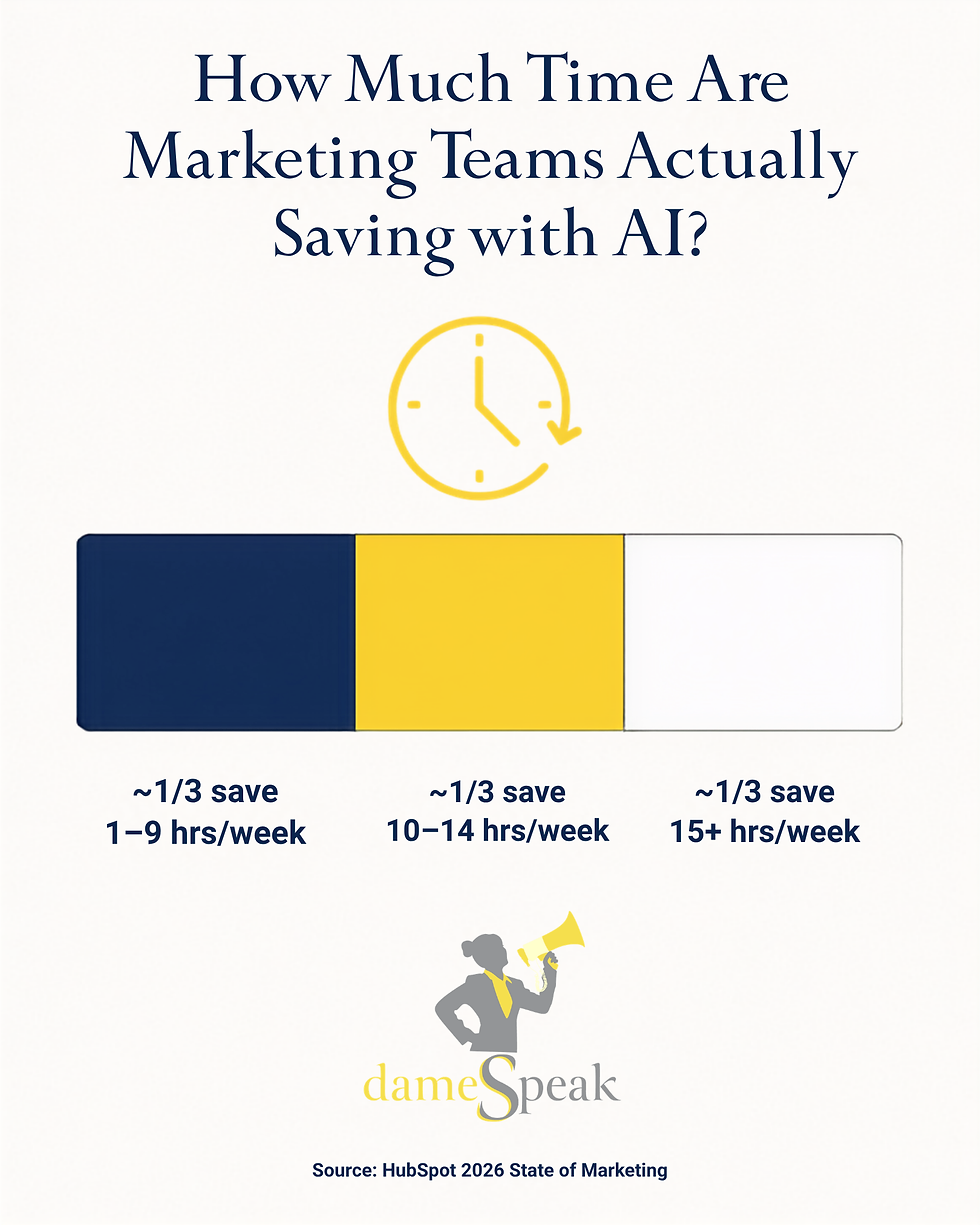
The time savings are the clearest, most consistently reported benefit. HubSpot's 2026 State of Marketing report found that about a third of marketing teams say AI saves them 10-14 hours a week, and another third say 15+ hours — meaningful time back for a small team wearing multiple hats.
Revenue impact is real but harder to isolate and much less universal than the adoption numbers suggest. If a vendor or headline promises a specific "X% revenue lift from AI" without naming the study behind it, treat it with real skepticism — most credible research (McKinsey included) is honest that the gap between "using AI" and "getting measurable profit from AI" is still wide industry-wide. The businesses closing that gap tend to have one thing in common: they picked a specific, well-defined use case first, instead of adopting a tool and hoping a use for it would appear.
How to Actually Get Started (Without Wasting Budget)
Pick one bottleneck, not five tools. Where does your team actually lose the most time — writing, scheduling, answering the same customer questions, or digging through data? Solve that one thing first.
Start with a tool you can cancel easily. Most AI marketing tools now offer monthly plans or free tiers. Test before you commit to an annual contract.
Keep a human in the loop. Every category above works best as a draft-and-review process, not a fully autonomous one — especially for anything customer-facing or brand-voice-sensitive.
Measure the specific thing you set out to fix. If you adopted a tool to save time on content drafts, track hours saved on content drafts — not vague "productivity."
Don't stop at rankings — think about AI citations too. As more customers ask ChatGPT or Google's AI Overview for recommendations instead of scrolling search results, the content and structure that gets you cited matters as much as the content that gets you ranked.
Frequently Asked Questions About AI-Driven Marketing Tools
Do I need a big budget to start using AI marketing tools?
No. Most tools worth trying — writing assistants, basic chatbot builders, ad platform AI features you likely already have access to — offer free tiers or low-cost monthly plans. The bigger cost is usually time spent testing and integrating a tool, not the subscription itself.
Which AI marketing tool should a small business try first?
Start with whichever bottleneck is costing you the most time right now, not the tool getting the most hype. For most small businesses, that's either a writing assistant for content drafts or a basic chatbot for routine customer questions.
Can AI marketing tools replace a marketing team or agency?
No — they replace specific tasks within marketing, not strategy, judgment, or brand voice. The businesses seeing real results treat AI tools as a way to move faster on execution, with a person still setting direction and reviewing output.
How is AI search optimization different from using AI marketing tools?
Using AI marketing tools means using AI-powered software to help run your marketing. AI search optimization (GEO and AEO) is about making your existing content more likely to be cited by AI systems like ChatGPT and Google AI Overviews — a different goal that uses different tactics. We cover this in our GEO & AEO guide.
Is it too late to start using AI marketing tools?
No. Adoption is high (88% of organizations use AI in at least one function), but McKinsey's own research shows most companies are still in early or pilot-stage use. There's still a real advantage available to businesses that pick the right tools and use them with a clear plan.
Related Reading
How to Get Cited in AI Search: GEO & AEO Guide · AI Search Optimization for Small Businesses · What Is GEO? · What Is AEO?
Sources
McKinsey & Company, "The State of AI: Global Survey 2025" — https://www.mckinsey.com/capabilities/quantumblack/our-insights/the-state-of-ai
Semrush, "Think Big with AI: Small Business Content Marketing" — https://www.semrush.com/content-hub/ai-content-marketing-report/
HubSpot, "2026 State of Marketing" — https://blog.hubspot.com/marketing/hubspot-blog-marketing-industry-trends-report


