
How Do You Find a Trustworthy Marketing Agency in Kansas City?

Updated: Aug 26

Key Takeaways
Vague pricing, guaranteed rankings, and account lock-in are red flags no matter what an agency says about AI.
73% of small business owners aren't confident their current marketing strategy is working — vetting matters, AI buzzwords or not.
"AI search" has become an easy label to bolt onto a pitch. Ask any agency to explain SEO vs. AEO in plain language before you sign anything.
Real AI search competence shows up as citation data and schema work — not a rankings screenshot with a new label on it.
Specificity is the actual antidote to buzzword skepticism. A vague, polished answer is the red flag — not an honest "here's what we're still learning."
You've probably already had the conversation. A marketing agency tells you they "do AI search optimization now," and you nod along, because you're not entirely sure what that means, and you're not entirely sure they do either.
That instinct is worth trusting. Nationally, 73% of small business owners say they aren't confident their current marketing strategy is actually working — and that was true before "AI search" became something every agency claims to offer. The vetting problem hasn't gone away. It's picked up a new buzzword.
This isn't a takedown of the agency world. It's a checklist — the same one we'd want a business owner to run us through.
The Standard Red Flags Still Apply First
Before you get anywhere near AI search, rule out the basics. These red flags show up in Kansas City the same way they show up everywhere else:

Vague pricing. "It depends" or "we'll need your budget first" as a first answer, before any pricing framework, is a stalling tactic — not a legitimate scoping question. For example, dameSpeak has base rates like $500 per month for social media management, $2500 for a website build, Ask what a similar-sized client pays and expect a real number.
Guaranteed rankings. No one — not Google, not an agency, not an AI platform — can guarantee a #1 ranking or a specific placement. Many of our clients rank #1 for certain terms but their rankings often fluctate with seasons or demand. We monitor and report the weekly and monthly ups and downs but focus on the overall trend. An agency that promises a guaranteed ranking is either inexperienced or hoping you won't ask again in three months.
Account lock-in. Ask directly: if we part ways, do we keep our Google Business Profile, ad accounts, analytics, and website access? If the answer is hesitant, that's not a partnership — that's leverage being held over you.
No direct access to decision makers. You meet the senior team during the pitch. Then you get quietly handed off to a junior account manager whose job is booking meetings and forwarding reports — not making decisions. That's not a partnership. That's a waiting room.
When something breaks (and something always breaks), you don't need someone managing your calendar — you need someone with enough context and authority to change course that day, not "let me check with the team and circle back." Ask directly who you'll actually be working with once the contract's signed, and whether that person can make a strategic call without running it by someone you'll never talk to. At dameSpeak, you'll always have access to leadership.
Reporting you can't act on. A monthly report full of impressions and "engagement" with no line connecting it to leads or revenue isn't a red flag by omission — it's a red flag by design. It's easier to report vanity metrics than to report ones you're accountable for.
None of this is new. What's new is that "AI search" has become the easiest buzzword to bolt onto a pitch without changing anything underneath it.
The Newer Test: Do They Actually Understand AI Search, or Are They Just Saying It?
This is the gap that's harder to spot, because most business owners don't yet have a reference point for what "good" looks like here. A few questions cut through it fast.
Ask them to explain the difference between SEO and AEO. SEO gets you ranked on a results page. AEO — Answer Engine Optimization — gets your content pulled into the actual answer a platform like ChatGPT or an AI Overview gives, often with no click to your site at all. These are related but different jobs, and an agency that can't articulate the difference in plain language almost certainly isn't doing the second one — they're just relabeling the first.
Ask for citation data, not just ranking data. Rankings tell you where you sit in traditional search. They tell you nothing about whether your business is being mentioned inside ChatGPT, Perplexity, or Google's AI Overviews. If an agency's "AI search reporting" is a rankings screenshot with a new label on it, that's the tell.
Ask how they handle structured data and schema markup. This is unglamorous, technical, backend work — and it's a large part of what actually makes a business legible to an AI system. We've seen clients go from unranked to ranked #1 in 60 days after we implemented structured data and schema markup. An agency that can't speak to it specifically, or waves it off as "not necessary," is telling you they haven't done the work.
Ask for one real, specific AI citation win. Not a case study PDF with stock language — an actual example: a client that now shows up when someone asks ChatGPT or Perplexity a relevant question, with a before-and-after. If they can't produce one, they may be selling a service they haven't actually delivered yet.
Here's what that actually looks like: one of our clients, a national reproductive technologies company competing in a specialized B2B market, now holds the #1 AI Visibility score against all five of its tracked competitors — reaching roughly 181,000 people a month through AI-generated answers alone, up nearly 10x since the work began, and cited across all four major platforms (ChatGPT, Google AI Overviews, AI Mode, and Gemini). That's not a rankings screenshot with a new label on it. That's the site actually being pulled into the answer when a buyer asks something like "cattle embryo transfer cost" or "bovine genetics companies." That's the level of specificity to ask for — a real audience number, a real citation count, tied to real questions your buyers are actually asking.
This distinction matters because the skepticism is warranted at an industry level. Nationally, 70% of marketing teams say they can't measure their own AI ROI, and most are using AI tools because they're available, not because they've proven they work. Regulators have started paying attention too — both the FTC and SEC have taken enforcement action against companies for vague or misleading claims about their AI capabilities. "AI-powered" has become easy to say and hard to verify. Your job as the person hiring the agency is to make them verify it.
What a Real Answer Sounds Like
A trustworthy agency's answer to "do you do AI search?" sounds specific, not smooth. It names what changes on your website, what data they track, what platforms they're optimizing for, and what still requires a person's judgment rather than a tool's output. Specificity is the actual antidote to buzzword skepticism — vague confidence is the thing to be wary of, not vague uncertainty. An agency that says "we're still learning how citation tracking works for smaller local businesses, but here's what we do know" is being more honest than one with a polished answer for everything.
A Quick Vetting Checklist
Before you sign anything, run a prospective agency through this:
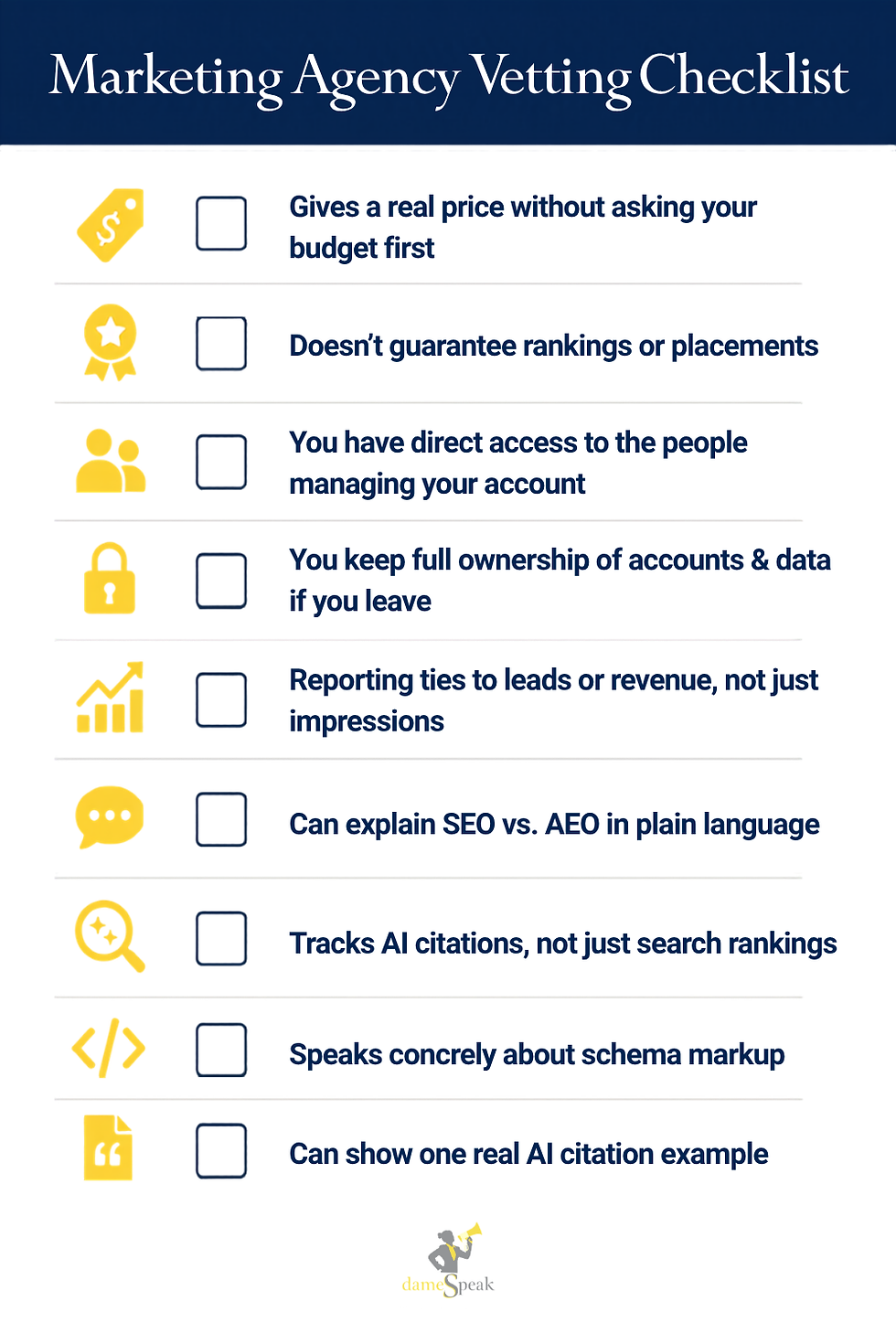
Can they give you a real pricing number without asking your budget first?
Do they guarantee rankings or placements? (If yes, that's disqualifying.)
Will you retain full ownership of your accounts, data, and campaigns if you leave?
Does their reporting connect to leads or revenue, not just impressions?
Can they explain, in plain language, the difference between SEO and AEO?
Do they track and report AI citations specifically — not just search rankings?
Can they speak concretely about structured data and schema markup?
Can they show you one real example of a client being cited in an AI answer?
If they stumble on the first five, that's a standard vetting failure. If they stumble on the last four, they're likely using "AI search" as a buzzword rather than a capability.
Frequently Asked Questions
What's the biggest red flag when hiring a marketing agency in Kansas City?
Guaranteed rankings and vague, budget-first pricing are the two biggest disqualifiers, regardless of what the agency claims about AI search. No agency can guarantee a specific ranking or placement — that's outside anyone's control but the platform's.
How can I tell if an agency actually understands AI search, or is just using it as a buzzword?
Ask them to explain the difference between SEO and AEO in plain language, ask for citation data (not just ranking data), and ask for one specific, real example of a client being cited in an AI answer like ChatGPT or Perplexity. Vague or overly polished answers are the tell, not honest uncertainty.
What's the difference between SEO and AEO?
SEO (Search Engine Optimization) is about ranking on a traditional search results page. AEO (Answer Engine Optimization) is about getting your content pulled directly into an AI-generated answer, often without any click to your website at all. They're related but distinct disciplines.
Should a marketing agency guarantee rankings or AI citations?
No. No agency, including dameSpeak, can guarantee a specific ranking or AI citation, because no agency controls Google's or an AI platform's algorithm. Any agency that guarantees a placement is overselling what's actually within their control.
What should I ask about a marketing agency's AI search reporting?
Ask whether their reporting tracks AI citations specifically (mentions inside ChatGPT, Perplexity, or Google AI Overviews) or only traditional search rankings relabeled as "AI search." Also ask how they handle schema markup, since it's foundational to AI visibility.
Where This Leaves You
Kansas City has no shortage of agencies now claiming AI search expertise, because it's become the thing to say. The checklist above won't tell you who's the best fit for your business — that still depends on your goals, budget, and industry. But it will tell you, fairly quickly, who's actually done the work and who's just updated their homepage copy.
If you want a second opinion on where your business currently stands — in traditional search and in AI search — our free AI Search Audit gives you a clear, no-pressure look before you commit to anyone.


